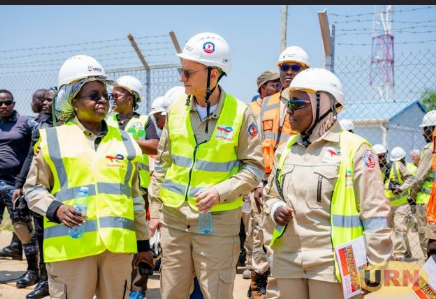
At the Kingfisher production site in Kikuube District, located by Lake Albert, President Yoweri Museveni attended on Wednesday to officially name Uganda’s crude oil blend — a significant event for the country’s much-anticipated oil sector.
This ceremony represents a key stage in turning nearly two decades of exploration and development into a product that can be traded on the market. Officials of the Uganda National Oil Company (UNOC) stated that the naming was the moment when Uganda’s oil “went from being known by what it is to being known by what it is called”.
The crude oil from Uganda, which is described as waxy and having a low sulphur content, needs to be transported through a heated pipeline when it is being exported because of its high density. Up to now, it has not had an official grade name that is used by international refiners, traders and buyers to indicate its quality, density, sulphur content and refining properties. Examples include the global benchmarks such as Brent Blend, Ghana’s Jubilee and Senegal’s Sangomar, all of which show the advantage of having a name for oil in terms of quoting, marketing and shipping it.
The event occurred at the Kingfisher Development Area, which is operated by CNOOC Uganda Limited. Together with TotalEnergies’ Tilenga project, Kingfisher is one of two major upstream developments and the two are expected to produce approximately 230,000 barrels per day at peak capacity, Kingfisher itself being designed to handle about 40,000 barrels each day. The crude oil will be transported via the 1,443-kilometre East African Crude Oil Pipeline (EACOP) to the port of Tanga in Tanzania for export.
Dr Monica Musenero, who is the Minister for Energy and Mineral Development, stated that the name would give Uganda’s oil recognition and allow it to stand out on the global market. “We do not want our oil to be known simply as ‘oil from Uganda’ but rather to be identified by its name. The name will be descriptive,” she told journalists before the ceremony. She stressed that Uganda would become the first entirely East African country to produce oil commercially.
By means of its ‘The Crude Truth’ campaign, UNOC had created a sense of anticipation, highlighting the idea that a blend must have a name in order to define its particular quality and composition. The company will then take a central role in the marketing of the crude when production starts.
Oil in commercial quantities was found in the Albertine Graben in 2006, and the sector saw substantial progress after the Final Investment Decision in 2022 brought in billions of investment dollars. The first oil is now expected for later this year, although the timeline has been adjusted on several occasions.
The naming ceremony is part of the president’s wider trip, which involves inspecting the oil infrastructure and the progress being made towards commercial production; major facilities close to Kingfisher are nearly completed and being put into operation, with EACOP also moving towards readiness.
The fact that it has been nearly 20 years since the country was discovered means that the simple step of giving it a name has both symbolic and practical significance; it puts Uganda’s crude oil on the international market and shows that the country is now at the final stage of becoming an oil-exporting nation. The officials state that the name, which has been carefully selected and is based on local traditions, will reflect the particular characteristics of the resource and Uganda’s national identity.
Now that the ceremony has ended, the focus shifts to the various operational milestones which will result in the first barrels reaching the surface and entering the global energy trade.
Uganda Names Its Crude Oil Blend Today