
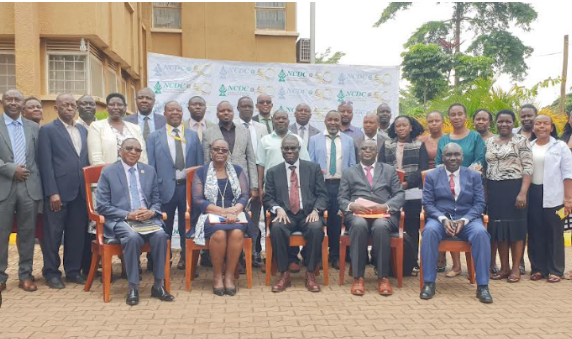
KAMPALA – Education experts from Uganda and beyond gathered at Speke Resort Munyonyo on Thursday for the opening of the second International Conference on Curriculum Development, organised by the National Curriculum Development Centre (NCDC).
The two-day event, running from 20 to 21 August 2026, is being held under the theme “Innovative Curriculum Approaches for Sustainable Education in a Globalised World.” It has attracted more than 700 delegates, including curriculum specialists, researchers, policymakers, teachers and development partners from over 11 countries.
Dr Bernadette Nambi Karuhanga, Director of the NCDC, said the conference provides a critical platform to examine how education systems can remain relevant amid rapid technological, economic and environmental changes. “A curriculum cannot remain static,” she noted. “Employers increasingly require adaptability, creativity, collaboration, communication and problem-solving alongside technical knowledge.”
Key discussions centre on the integration of artificial intelligence and ICT in learning, the preservation of indigenous knowledge systems, sustainability, global citizenship and the need to decolonise curricula so that African learners are not disconnected from their own societies and realities.
Prof. Benson Banda, Director of Zambia’s National Science Centre and one of the keynote speakers, challenged participants to rethink education design. He argued that the question is not simply how to improve existing curricula but “how do we redesign education so that it truly works for Africa, by Africa and with Africa?”
UNICEF Uganda Representative Dr Robin Nandy emphasised the urgency of investing in young people. He pointed out that roughly 70 to 75 per cent of Uganda’s population is below the age of 30, with more than half being children. “Uganda cannot achieve its development ambitions without investing in the knowledge, skills and capabilities of its children and young people,” he said.
The conference comes at a time when Uganda is deepening its shift towards competence-based education across primary, secondary and higher levels. The lower secondary competence-based curriculum is already in place, while reforms for primary education and A-level are scheduled for rollout by 2028. Higher education institutions are simultaneously reviewing programmes to align with the new approach.
Seventy-seven research papers were selected from 130 submissions after a rigorous peer-review process. Sessions include keynote addresses, panel discussions, poster presentations and exhibitions covering interdisciplinary approaches, localisation of curricula and the role of media in supporting education reforms.
Stakeholders have used the platform to call for stronger teacher preparation, improved school infrastructure and careful sequencing of reforms to avoid the challenges experienced during earlier curriculum transitions.
The conference continues on Friday with further presentations and recommendations expected to guide Uganda’s ongoing education transformation. Organisers say the outcomes will help strengthen a resilient, inclusive and future-ready education system capable of producing graduates equipped for both local and global opportunities.
As Uganda positions itself to compete in a rapidly changing world, the Munyonyo gathering underscores the central role of curriculum in shaping the country’s human capital and long-term development.