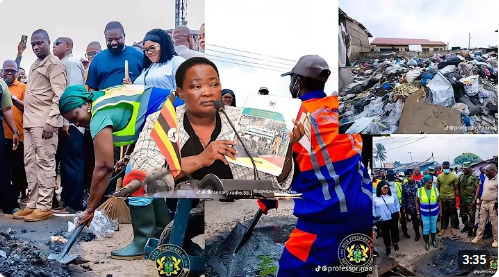
Kampala, July 26, 2026 — Streets emptied, markets quieted and communities across Uganda took to brooms, rakes and wheelbarrows on Saturday as the country observed its first mandatory National Cleaning Day, a monthly initiative aimed at tackling poor sanitation and preventable disease.
Vice President Jessica Alupo officially launched the programme in Kiti Zone, Kisenyi III Parish in Kampala Central Division, on behalf of President Yoweri Museveni. She was joined by Prime Minister Robinah Nabbanja, Health Minister Dr Chris Baryomunsi, the Inspector General of Police, Kampala Capital City Authority Executive Director Sharifah Buzeki and other leaders.
“Let us make cleanliness a daily habit, not an occasional activity. If each of us plays our part, Uganda will be clean, healthy, and prosperous,” Alupo said. She stressed that the exercise is about changing mindsets rather than staging one-off ceremonies. Cleaning, she added, must start at household level and extend into communities because “Uganda belongs to all of us.”
The government has designated the last Saturday of every month, from 7:00 a.m. to 10:00 a.m., as National Cleaning Day. During those three hours, non-essential movement of people and vehicles is restricted, and businesses are expected to close. Exemptions cover emergency services, security operations and, after initial complaints, certain tourism-related activities.
Prime Minister Nabbanja, who announced the policy earlier in the week, described it as a whole-of-government and whole-of-society effort approved by Cabinet in August 2025. Authorities cite high rates of sanitation-related illness, with officials previously noting that a large share of the disease burden and significant child mortality is linked to poor hygiene and unmanaged waste. Kampala alone generates thousands of tonnes of solid waste daily, much of which goes uncollected and blocks drainage systems.
Reports from across the country indicated solid participation. In Soroti, local leaders including former Works State Minister Musa Ecweru joined residents at Independence Square. Similar turnouts were observed in Mbarara, Mukono, Arua, Lira and parts of Kampala, where market vendors and residents cleared streets, drainage channels and public spaces. Government accounts later described the morning as “four hours well spent.”
Not everyone welcomed the approach. Exiled lawyer and author Kakwenza Rukirabashaija called the directive unconstitutional, arguing that Cabinet exceeded its authority by imposing binding obligations without parliamentary legislation. He said the circular conflicts with several constitutional provisions, duplicates existing duties under the Local Governments Act and Public Health Act, and places an unreasonable extra burden on citizens who already fund sanitation through taxes.
Members of the Seventh-day Adventist Church also raised concerns that the exercise falls on their Sabbath. Health Minister Baryomunsi responded that the early-morning window was chosen deliberately so people could complete the work and still attend to other activities, including worship. He referenced biblical teachings on helping those in need even on the Sabbath and urged broad participation for the sake of public health.
Journalists and some observers welcomed the goal of cleaner neighbourhoods but cautioned against treating the day as mere symbolism. Success, they argued, will depend on sustained daily behaviour change, reliable waste-collection systems and infrastructure rather than monthly enforcement alone. Social media reflected the mixed mood: praise for cleaner streets sat alongside complaints about disruption, questions about long-term impact and calls for government to first improve its own waste-management services.
Police had warned that the restrictions would be enforced, drawing comparisons with measures used during the COVID-19 period. By late Saturday, official messaging focused on the positive turnout and the message that a clean Uganda is a shared responsibility.
The next National Cleaning Day is scheduled for the last Saturday of August. Whether the initiative evolves into a lasting culture of civic hygiene or remains a contested monthly ritual will depend on how government, local leaders and ordinary citizens respond in the months ahead.